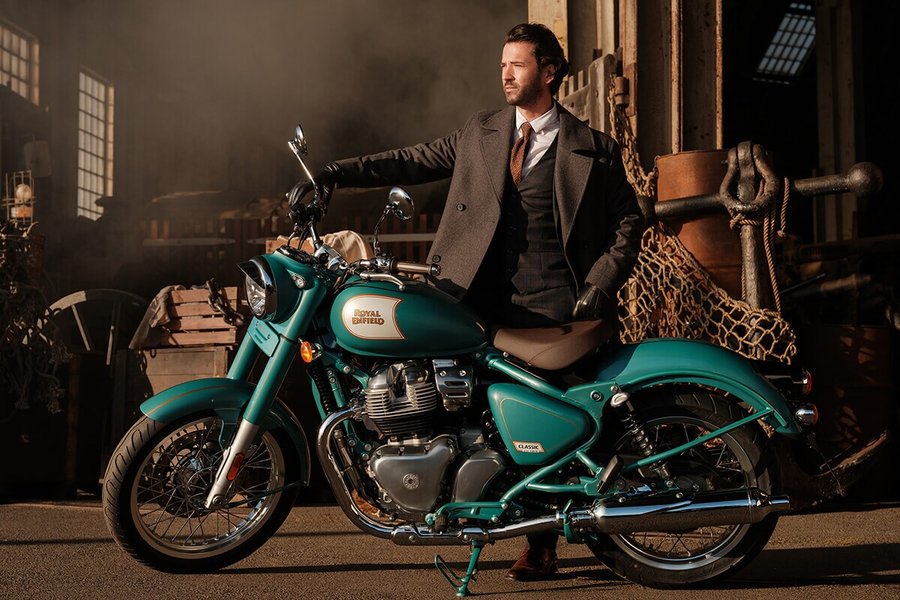
There is a shape motorcycling keeps returning to, the way English architecture keeps returning to the sash window. A rounded tank narrowing to the knees. A single round headlamp set low between the forks. Mudguards that follow the wheels rather than argue with them. It was settled between the war and the middle of the fifties, and nothing since has improved on it.
The Royal Enfield Classic 650 is that shape, drawn full size and given an engine equal to it: the 648cc air- and oil-cooled parallel twin that has, since 2018, quietly become one of the most likeable engines built anywhere. It is not a fast motorcycle, and Royal Enfield is unembarrassed about that. It is something rarer — a machine whose proportions, sound and pace agree.
Why This Machine
A collection of the world's most beautiful machines tends, by gravity, toward the rare and the ruinous — the hand-built, the numbered, the object insured before it is enjoyed. The Classic 650 belongs for the opposite reason. It is a beautiful motorcycle an ordinary person can buy, ride through winter, and forget to polish. Beauty that survives use is the harder achievement.
It belongs, too, because the shape is not a costume. Most retro motorcycles are the work of designers who studied photographs and reverse-engineered a mood. Royal Enfield never had to research the period, because it was there. It has built motorcycles continuously since 1901, and the Classic's visual language is not a quotation but a family resemblance. The pinstripe is on the tank because it always has been.
And it belongs because of what it asks of the rider. A machine of this shape and this power is not a device for compressing distance but for lengthening it. It favours the rider who takes the lane beside the river rather than the carriageway that crosses it — rare, in a market that measures motorcycles as it measures broadband.
The Beauty
Begin with the tank, because everything else is arranged around it. It is a teardrop in the old sense: a form that swells at the front, holds its fullness through the middle and tapers to the seat, with knee recesses where a rider's legs actually fall. Modern tanks are angular shrouds over a plastic vessel. This one is simply the shape it appears to be.
Over that shape goes the pinstriping, the detail that most clearly declares the machine's intentions. The lines running the length of the tank and around the badge are hand-applied — laid down with a brush, by a person, one motorcycle at a time. The technique survives almost nowhere else in mass production, and it makes a slight variation a signature rather than a flaw.
Then the casquette: Royal Enfield's word for the headlamp nacelle, a cast housing carrying the main lamp with two pilot lamps in its brow and the instruments in its crown. Inherited from the company's British machines of the 1950s, it does what no bare headlamp can. It gives the motorcycle a face, and buries the wiring and clocks out of sight.
The rest holds the line: wire-spoked wheels, a nineteen-inch front and eighteen-inch rear — the classical proportion, a tall front wheel making a motorcycle look poised rather than crouched. Deeply valanced steel mudguards, a chromed exhaust low along the flank, twin rear shocks, because a monoshock would hide the frame triangle the shape depends on. The launch palette shows the same restraint: a deep Vallam Red, a soft period Teal, a Bruntingthorpe Blue named for the Leicestershire site of the company's UK technology centre, and a Black Chrome that shifts as you walk around it. All look as though they were mixed in the 1950s.
The Power
The 648cc twin makes somewhere in the region of 47 brake horsepower. Written down, beside almost anything else with two cylinders and a middleweight price, that is unremarkable. Ridden, it is the least relevant fact about the engine. What matters is the shape of the delivery, and that shape is unusually generous.
The twin uses a 270-degree crankshaft, staggering the firing intervals so it behaves less like pistons rising in unison and more like a V-twin laid across the frame. Torque arrives early, spreads wide and never feels rationed. It pulls cleanly from just above idle and will happily be ridden two gears higher than seems reasonable.
Then there is the noise. A 270-degree twin produces an offbeat, loping exhaust note — a syncopated pulse rather than the flat drone of a conventional parallel twin — and enough survives the standard system. At small throttle openings it burbles; opened up, it hardens into something with real chest. A genuine pleasure, and it costs the owner nothing.
Smoothness matters more here than peak output, and it is why this engine works beneath this bodywork. The Classic 650 is substantial, well over two hundred kilograms with fluids aboard, and that weight paired with an unstrained engine produces a particular quality of motion. It settles. More power would have started an argument with the shape.
The History Behind It
The story begins in Redditch, Worcestershire, at the end of the nineteenth century. The firm that became Royal Enfield supplied precision parts to the Royal Small Arms Factory at Enfield, and took from it a name and a motto — Made Like A Gun — it has never abandoned. Its first motorcycle followed in 1901, and nothing has interrupted the line since: the oldest motorcycle brand in continuous production.
The Bullet name first appeared in the 1930s and became the defining product after the Second World War, when the postwar 350 gained swinging-arm rear suspension at a time when most British machines still had rigid rear ends. Durable, torquey and forgiving of poor roads, it caught the eye of the Indian Army, which ordered Bullets in quantity for patrol work in the early 1950s.
What followed is the strangest turn in the company's history. Rather than ship complete machines indefinitely, manufacturing was established in Madras — now Chennai — in the mid-1950s, first assembling Bullets from British kits, then building them outright. The British parent did not survive: Redditch wound down at the end of the 1960s. The Indian operation carried on. The brand did not die; it emigrated.
"Royal Enfield is the only motorcycle company that outlived its own homeland. The factory in Redditch closed; the motorcycle did not. It simply kept being built, six thousand miles away, by people who saw no reason to stop."
The modern chapter began around the turn of the century, under an ownership that recognised it had not a nostalgia business but an unbroken one. Investment followed, then modern engines, then a proper parallel twin. Developed jointly at the technology centre in Leicestershire and the engineering operation in Chennai, the 648cc unit arrived in 2018 beneath the Interceptor 650 — whose name recalls the big twins Enfield built for America in the 1960s — and the Continental GT 650, named for the sharp little 250 of 1965. They were the best motorcycles the company had made, and the platform has since carried a growing family. The Classic 650 is the most direct of them: that engine and architecture, dressed in the shape Redditch drew. Less a new model than a reconciliation.
What It Costs
In India, where it is built, the Classic 650 sits in the region of ₹3.4 to ₹3.6 lakh ex-showroom, varying by colourway — Black Chrome carries a premium over the solid colours — and rising meaningfully once road tax, registration and insurance are added.
Export markets pay more, once shipping, duty, homologation and dealer margin are added. In the United Kingdom it lands around the six-thousand-pound mark on the road; in the United States near seven thousand dollars before taxes and fees; in Europe between the two once VAT applies. All figures here are indicative and approximate as of early 2026, and vary by market, specification, dealer and local duties.
Against that, running costs are unusually gentle. The 650 platform has been in the world the better part of a decade, servicing is inexpensive by middleweight standards, insurance is modest, and consumables are cheap. It costs little to keep, which is part of why it is ridden rather than stored.
Where to Find One
Royal Enfield's dealer network is among the broadest in motorcycling — a legacy of enormous domestic scale and a deliberate export push. Availability is rarely the problem; colour sometimes is, particularly for the premium finishes, which arrive in smaller numbers.
| Market | Availability | Indicative Price |
|---|---|---|
| India | Widest availability; built domestically and sold through a very large dealer network. Premium finishes can require a wait. | From approx. ₹3.4–3.6 lakh ex-showroom |
| United Kingdom | Strong coverage nationwide; a core model rather than a limited import, so stock is generally straightforward to find. | Approx. £6,000 on the road |
| United States | Sold through the established dealer network; coverage is good in motorcycling states, thinner in some rural regions. | Approx. $7,000 before taxes and fees |
| Europe (EU) | Available across most major markets. Local pricing shifts noticeably with national VAT and registration rules. | Approx. €6,500–7,500 depending on country |
| Australia | Distributed nationally through authorised dealers; ride-away pricing includes on-road costs that vary by state. | Approx. AU$11,000–12,000 ride away |
| Canada | A smaller but established dealer network, concentrated in the larger provinces. | Approx. CA$9,000–9,500 before taxes and fees |
All figures above are indicative and approximate as of early 2026, and differ by dealer, specification, colour and locally applied taxes, duties and registration charges.
One piece of practical advice: go and look at the colours in person. Photographs flatten the Black Chrome and make the Teal brighter than it is. Both are better in daylight, and the difference is worth an afternoon.
What Makes It Unlike Anything Else
The modern classic category is crowded, and most of what fills it is a well-executed impression. Several rivals are quicker, better-braked and more sophisticated. Not one is doing the same thing. They are contemporary motorcycles wearing a historical style; this is a historical motorcycle kept in production long enough to become contemporary again — which cannot be manufactured retrospectively.
The distinction shows up in unexpected places. In the way the machine is comfortable being unhurried, because it was drawn when nothing else was available. In the absence of the anxieties of expensive retro machinery — nobody protects a Classic 650 from the weather. In the fact that a company with a century of unbroken production need make no fuss about heritage, and does not.
There is a democratic quality to it, too, which is no small thing on a website concerned with inherited taste. The Classic 650 is one of very few genuinely beautiful objects in motorcycling not gated by wealth; it asks nothing of its owner but the wish to ride it. And there is the coherence: look, sound, weight, pace and price all argue for the same thing. Most motorcycles compromise between a design brief and a marketing target. This one reads as though somebody decided what it ought to be, then built exactly that.
Ride one on a spring morning, on a road that goes nowhere in particular, and the argument makes itself: the offbeat twin loping beneath you, chrome catching low sun, the long line of the tank running toward that stern little casquette — and behind it, invisible but present, a century of a factory that never stopped. Made like a gun, as they said in Redditch. They meant it then, and the shape says it still.