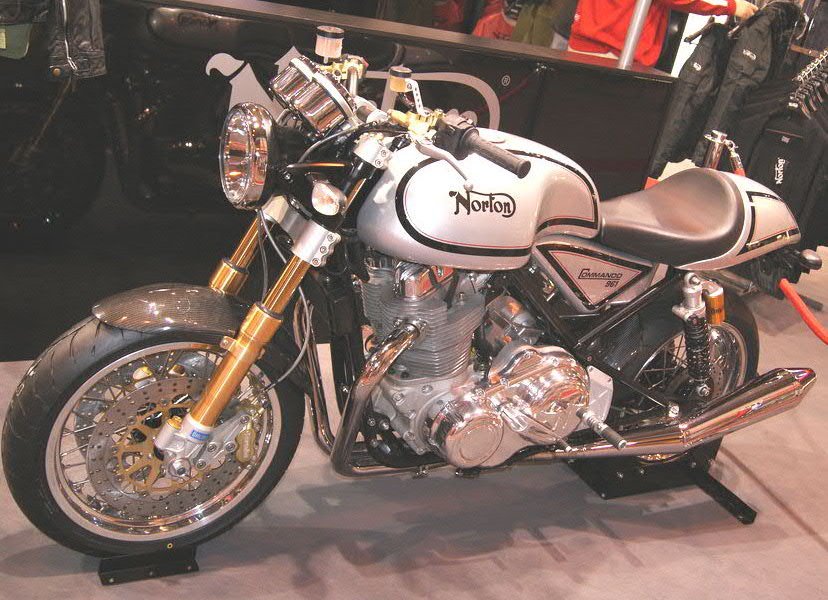
Standing in front of a Norton Commando 961, you realise you are not looking at a product. It sits low and long on wire wheels, tank narrow at the knee, silencers running back on either flank like the barrels of a well-kept shotgun. It looks less like something engineered to a brief than something that arrived from another decade and was kept up.
That impression is not an illusion. The 961 is genuinely old-fashioned where it matters — air-cooled, pushrod-operated, built by hand in small numbers — and modern where it counts, with Öhlins suspension and Brembo brakes. It also carries a new weight: Norton confirmed in 2025 that the 961 had reached the end of its run, unveiling a wholly new range at EICMA that November. For the first time in the marque's modern history, there is no Commando in the catalogue.
Why This Machine
The industry now builds fast, competent motorcycles very well and memorable ones badly. Much of what is sold as heritage is a styling exercise over a liquid-cooled engine and a corporate chassis — a decision taken late, after the important choices were made. The Norton is the other thing.
Air cooling means no radiator, and no radiator means the engine is the front of the motorcycle: fins visible, cases visible, nothing behind plastic. A parallel twin means a narrow machine, and therefore the low, unbroken line from headstock to tail that no bodywork can fake. Twin shocks mean a classic triangle at the back, not the hump of a monoshock.
So the 961 belongs in the same conversation as a bench-made shoe or a waxed cotton jacket: built the difficult way because the difficult way produces what the easy way cannot. Stand it beside a 1970 Commando and the resemblance is in the bone structure, not the paint.
The Beauty
Start with the proportions. The roadster stance depends on relationships most modern motorcycles have abandoned: a level line from tank to tail, wheels of similar visual weight, an engine that fills the frame, a riding position that lets you sit on the machine rather than crouch over it. Norton did not rediscover these. They are what a British roadster is.
Then the finish. The 961 is assembled by hand, and the evidence is in the parts others would have cheapened: polished and brushed alloy where alloy belongs, yokes machined from billet, brackets finished rather than merely made. The tank's pinstripe is hand-applied — in Solihull, a steady hand and a lining brush account for the most noticeable line on the motorcycle.
The exhausts deserve their own sentence. Twin silencers run low and long down each flank in the peashooter idiom that has belonged to British twins since before the war: slim, tapering, unapologetically symmetrical. They are among the last arguments that an exhaust is part of a motorcycle's shape rather than a component to hide.
Finally, and least fashionably, rarity. Norton never built the 961 in volume — low thousands across its lifetime, not the tens of thousands that define a mainstream model. With production ended, that number is fixed. Every 961 that will exist already does.
"A motorcycle built in small numbers by hand is not a limited edition. It is the honest output of a factory that refused to build any other way."
The Power
The numbers plainly, so nobody is misled. The 961cc air-cooled twin makes somewhere near 77 horsepower, with roughly 80 newton-metres of torque available well before it. Bore and stroke are 88mm by 79mm, the crankshaft runs at 270 degrees, and the valves are worked by pushrods with hydraulic lifters. Against a modern middleweight these figures are unremarkable. Against the purpose of the machine, they are right.
Tuning a big twin for peak output is a destructive exercise: you raise the revs at which the engine does its best work, narrow the band in which it feels alive, and trade away the tractability that makes a road bike pleasant on a wet lane in February. Norton went the other way. The 961 pulls from low down in tall gears, unhurried enough that you rarely change down.
The 270-degree crank is central to the character. It gives the engine an uneven firing interval — the loping beat between the flat drone of a 360-degree twin and the bark of a V-twin — and lets the rider feel what the rear tyre is doing. At small openings it burbles; at a third throttle it hardens into something deep and slightly indignant. It is not loud so much as present, the way a horse is present under you.
The History Behind It
Norton begins in 1898, when James Lansdowne Norton set up in Birmingham making fittings for the young two-wheel trade. Within a decade the name was attached to something more glamorous: at the first Isle of Man TT in 1907, a Norton ridden by Rem Fowler won the twin-cylinder class. It set the pattern the marque has followed ever since.
The most important thing Norton ever made was not an engine. At the turn of the 1950s the McCandless brothers produced a duplex loop frame of such poise that Geoff Duke is said to have compared riding it to riding a featherbed — and the Featherbed frame took its name from the remark. When people say the British were beaten on power but never on handling, this is what they mean.
The Commando arrived at the Earls Court Show in 1967. Its 745cc overhead-valve twin developed an already elderly design, and it vibrated. Norton's answer, from a team including Dr Stefan Bauer, Bernard Hooper and Bob Trigg, was the Isolastic system: engine, gearbox and swinging arm mounted together in rubber isolators, so the vibrating assembly moved as one piece and the rider was insulated from it. Readers of Motor Cycle News voted the Commando Machine of the Year five years running, 1968 to 1972.
It did not save the company; nothing could have. The engine grew to 828cc in 1973, the year a government-backed merger created Norton Villiers Triumph from the wreckage of the British industry, and by October 1977 Commando production had ended — some sixty thousand machines in all. The name then passed between hands: in Oregon, Kenny Dreer developed an all-new 961 before funding ran out in 2006; in 2008 Stuart Garner acquired the rights and set up at Donington Park, a business that entered administration in January 2020.
What followed is the most consequential thing to happen to Norton in fifty years. In April 2020 TVS Motor Company of India acquired the Norton assets for a reported £16 million, then did what the brand had needed for decades: it built a factory. A new facility at Solar Park in Solihull opened in November 2021, and the reworked Commando 961 followed in 2023 — Öhlins, Brembo, an engine revised for consistency over headline output.
What It Costs
All figures here are indicative and approximate as of early 2026. Pricing varies enormously by market, specification, model year, on-road charges, taxes and import duties. Treat what follows as a guide, not a quotation.
In the United Kingdom, its home market and by far its most straightforward, the Commando 961 was listed at its 2023 launch at roughly £16,500 for the SP and about £17,000 for the CR, before on-the-road costs. That is well above the mainstream modern classics, in territory held by low-volume specialists.
Elsewhere the arithmetic is less reliable. A rough sterling conversion puts the machine near the twenty-thousand-dollar mark before duty, shipping or homologation, and where it arrives fully imported those additions are substantial. It costs what a hand-built British twin has always cost: more than the rational alternative.
Where to Find One
Norton's distribution has never been broad, and with the 961 out of production it is narrower still. In most markets the realistic route to one is the used market, remaining dealer stock, or a specialist importer. The table below is a general guide; confirm current availability with Norton directly.
| Market | Availability | Indicative Price |
|---|---|---|
| United Kingdom | Strongest. Established dealers, deepest used supply; new bikes limited to remaining stock. | Approx. £16,500 (SP) / £17,000 (CR) at 2023 list; used values vary |
| Europe | Limited. Thin dealer presence; many buyers source from the UK. | Approx. €19,000–€21,000 equivalent, before local taxes |
| United States | Restricted. No conventional retail network; interest has outrun supply. | Approx. $20,000 equivalent before duty and compliance |
| India | Not yet established. TVS has confirmed Norton's Indian entry, with early machines expected as imports. | Not established; imports attract heavy duty |
| Australia | Very limited. No broad official network; specialist and private imports. | Import-dependent; a premium over UK list |
| Japan | Very limited. A small classics market served by independent importers. | Import-dependent; specialist pricing |
Two practical notes. Because the 961 spans more than one ownership era, know which machine you are looking at: a Donington-built example from the 2010s and a Solihull-built 2023-onward bike differ in specification, finish and parts support.
And buy on condition and history. On a low-volume motorcycle, service records and a dealer who knows the model are worth more than a few hundred pounds of negotiation.
What Makes It Unlike Anything Else
Every manufacturer sells a heritage motorcycle now. Almost all are excellent; almost none are actually old — modern machines in period clothing. The Commando 961 is a stranger thing: a motorcycle whose retro character is structural rather than cosmetic, built by a company declared finished more than once and not finished yet.
What that produces has no true equivalent at any price. There are faster twins, smoother twins, cheaper twins and more sensible twins. There is nothing else combining air-cooled architecture, hand finishing, a lined tank, peashooter pipes, a name with a hundred and twenty-eight years behind it, and a production run now closed.
And there is the quieter thing. The 961 assumes its owner will keep it — not use it up, not trade it at three years, but keep it, learn it, hand it on. That is an assumption almost nothing in the modern market will make, and precisely the one a good saddle and a good pair of boots make.
The Commando has died before and come back. Whether it returns again is a question for another decade. For now the 961 sits where the best British machines have always sat: slightly behind the times, well ahead of the argument, and looking like something you inherited rather than bought.