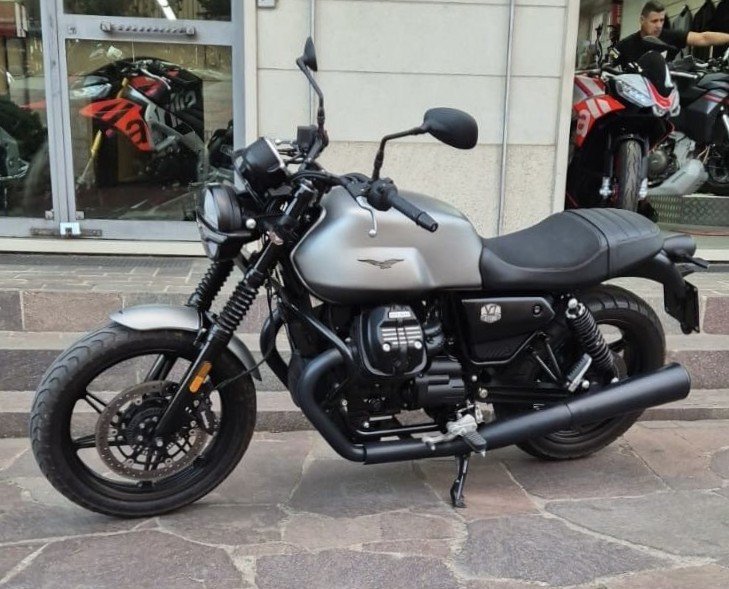
Every other motorcycle hides its engine. It tucks the cylinders between the frame rails, wraps them in a radiator and a fairing, and hands the rider a smooth flank of plastic. The Moto Guzzi does the opposite. It puts two cylinders out sideways into the wind, one either side of your shins, where anyone on a pavement in Milan or Marylebone can see exactly what is going on.
The V7 Special is the most traditionally dressed of the family: wire-spoked wheels, chromed mudguards, a teardrop tank with the eagle on the side, a flat seat of the kind built before anyone thought to sculpt them. Not the fastest thing in the showroom, nor the cleverest — simply the one built on the eastern shore of Lake Como by a factory that has not stopped since 1921.
Why This Machine
There is a category of object that survives not by improving but by refusing. A Purdey shotgun, a Cordovan boot, a mechanical watch with a sweep second hand. None wins a specification contest; none is trying to. They persist because the thing they do has never been bettered, only bypassed. The V7 belongs on that shelf: a layout settled in the 1960s and refined rather than replaced ever since.
What it offers, more than performance, is legibility. You can look at it and understand it. The cylinders are where combustion happens; the shaft is where the drive goes. Nothing is disguised as something else, and nothing is styled to imply a capability the machine does not have. In a market full of retro bikes in costume, the Guzzi is not in fancy dress.
It is also, quietly, good value. For roughly the money that buys a competent parallel-twin built to a global template and sold in enormous numbers, the V7 Special buys a low-volume Italian machine with an unusual engine, shaft final drive, and unbroken provenance back to 1921. That is not nostalgia. That is arithmetic.
The Beauty
Start with the cylinders, because everyone does. The transverse ninety-degree V-twin carries its crankshaft fore and aft, which throws both barrels out into the airstream. From the saddle you are riding something with shoulders. The finning catches low sun; in cold weather you feel the left-hand pot warming your knee. It is the most sociable engine layout ever built, talking to the world rather than sulking behind bodywork.
Then the badge. The Moto Guzzi eagle — wings spread, head in profile — is one of the few motorcycle emblems that would not look out of place cast into a bronze door handle or embroidered on a regimental blazer. It is no logotype from a consultancy but a heraldic device with a reason for existing, and it has been on the tank, in one form or another, for a century.
The tank is the other half of the argument: a proper teardrop, wide at the knees, tapering to the seat, in the two-tone paint Italian factories used when paint was the cheapest way to look expensive. Around it the design borders on austerity — round headlamp, round instruments, chrome only where it earns its place. No fake intakes, no plastic pretending to be metal.
All of it comes out of a building that ought to be more famous. The Mandello del Lario works sits on the lakeshore between water and mountains, in a town small enough that factory and community are one thing. Riders have made the pilgrimage for generations. A company that has spent a century looking at that view was never going to build an ugly motorcycle.
The Power
The current V7 runs an 853cc air-cooled twin, shared in its essentials with Guzzi's larger V85, making somewhere near sixty-five horsepower. On paper that is unremarkable. On the road it is exactly, almost suspiciously, right. The engine is best in the middle of its range, pulling with a long, even, slightly agricultural surge that asks only that you be near the correct gear.
Sixty-five is the right number for the same reason a good hunter is not a racehorse. Enough is a specification. It holds a motorway pace, makes a B-road entertaining, and declines to produce the kind of trouble that requires a solicitor. A more powerful V7 would need stiffer suspension, bigger brakes, more mass and more electronics — and would no longer be a V7. The restraint is the engineering.
Then the drivetrain, where the Guzzi separates itself entirely. The longitudinal crankshaft feeds a shaft drive straight back to the rear wheel: no chain to adjust, no lubricant flung across your boots, no sprockets to replace. It is the arrangement of a machine meant to be ridden a long way by someone who would rather not carry a chain tool.
And it rocks. Blip the throttle at a standstill and the whole motorcycle leans gently to one side, then settles — the crankshaft's rotating mass pushing against the chassis, proof that a real engine is down there doing real work. Every Guzzi owner learns to do this in front of an audience, and every one pretends to be checking the throttle cable.
The History Behind It
The company was founded in 1921 at Mandello del Lario by Carlo Guzzi, the engineer, and Giorgio Parodi, an aviator from a Genoese shipping family whose money made it possible. The two had met in the Italian air corps during the First World War alongside a third man: Giovanni Ravelli, a pilot and racing motorcyclist who was to have joined them. Ravelli was killed in a flying accident in 1919, before the company existed. The eagle, emblem of the corps in which the three had served, was adopted in his memory.
What followed was a century of serious engineering in an unfashionable place. Guzzi built a wind tunnel at Mandello in 1950, believed to be the first at any motorcycle manufacturer, and used it on racing machines of extraordinary ambition — culminating in the eight-cylinder 500 Grand Prix bike of the mid-1950s, still among the most remarkable objects the sport has produced. Guzzi took multiple world championships before leaving Grand Prix racing at the end of 1957.
"A century in one town, on one lake, building an engine nobody else would build. Moto Guzzi's achievement is not that it innovated — everybody innovates. It is that it never once lost its nerve."
The V7 itself began as a government requirement. In the early 1960s the Italian state wanted a large, durable motorcycle for police and official duties, and Guzzi answered with a transverse V-twin descended from an engine developed for a military light vehicle, the Mulo Meccanico. The V7 entered production in 1967 at 703cc, and the layout proved so sound it underpinned everything Guzzi built for half a century: police fleets across Italy, the American-market California, the Lino Tonti-framed V7 Sport of 1971.
Guzzi has made motorcycles on the same site continuously since 1921, a claim almost nobody else in Europe can make, through periods that ruined better-capitalised rivals. Aprilia acquired Moto Guzzi in 2000; the Piaggio Group acquired Aprilia in 2004, and Guzzi has been part of Piaggio ever since. That ownership funded the renovation of the Mandello works around the 2021 centenary. The eagle has changed hands. It has never changed address.
What It Costs
All figures here are indicative and approximate as of early 2026. Pricing varies substantially by market, model year, trim and dealer, and — decisively — by local taxes, registration charges and import duties, which in some countries exceed the manufacturer's price. Treat what follows as a sense of scale, not a quotation.
Broadly, the V7 Special sits around nine and a half thousand US dollars, eight and a half thousand pounds, or nine and a half thousand euros before on-road costs: above the accessible end of the retro market, comfortably below the German and British premium twins it is cross-shopped against. Colours, luggage and the accessory catalogue move the number, as does the choice between trim levels.
The used market rewards patience. Guzzis tend to be bought by riders who look after them, and the 850 generation has been in production since the early 2020s, so tidy low-mileage examples appear regularly. Servicing is conventional — the valve clearances are accessible in a way that would make a modern four-cylinder owner weep — and the shaft drive removes a consumable entirely.
Where to Find One
Moto Guzzi's dealer network is unevenly distributed: dense in Italy, solid across western Europe and Britain, respectable in the United States and Australia, thin elsewhere. Before committing, confirm not only that a dealer can sell you the bike but that someone within a sensible distance can service it.
| Market | Availability | Indicative Price |
|---|---|---|
| Italy & Western Europe | Strongest network; home market, widest colour and accessory choice, deepest used supply | From approx. €9,500 before registration and local taxes |
| United Kingdom | Established importer and a modest but stable dealer network, concentrated in England | From approx. £8,500 on the road, dealer dependent |
| United States | Sold through the Piaggio Group network; coverage varies sharply by state | From approx. $9,500 before freight, setup, tax and title |
| Australia | Official distribution in the major cities; regional servicing requires planning | Broadly AU$16,000–18,000 ride-away, subject to on-road costs by state |
| India | No consistent official presence for the V7 in recent years; realistically an import or a private sale | Landed cost can approach twice the European figure once duties apply |
| Japan | Long-standing importer presence; a small but genuinely knowledgeable enthusiast market | Broadly comparable to European pricing once consumption tax is added |
Sit on one before you buy. The V7 is narrow and low-seated, and suits a wider range of riders than the specification implies — but the width of the cylinders at the ankle is something people either love immediately or never stop noticing.
And if you are anywhere near northern Italy, buy it there and ride it home. The road along the eastern shore of Lake Como, past the factory gates, is not a bad first hundred kilometres.
What Makes It Unlike Anything Else
There are perhaps four or five motorcycle engine layouts left with a real character of their own, and Moto Guzzi owns one outright. Nobody else builds a transverse V-twin for the road; nobody else has for decades. Buying a V7 is not buying a variation on a theme a dozen factories are also playing. It is buying the only surviving example of an idea.
It also asks something of the rider that most modern motorcycles have stopped asking. The V7 is not a machine you conquer, nor one that flatters you. It is one you settle into: it rewards smoothness, punishes hurry with nothing worse than mild indifference, and improves the further you get from a city. It is a well-cut tweed jacket — better company at year fifteen than at week one.
Behind all of it stands the thing that cannot be manufactured. A century in one town. A badge honouring a pilot who died before the company existed. A factory on a lake, a wind tunnel from 1950, police contracts and world championships and a family of engines that outlived every fashion sent to replace them. Most heritage motorcycles borrow a past. The V7 Special never had to.
Which is, in the end, the old-money argument for it. The V7 does not announce itself, and does not need to. It sits in the corner of the car park with its cylinders in the air and its eagle on the tank, and the people who know, know.