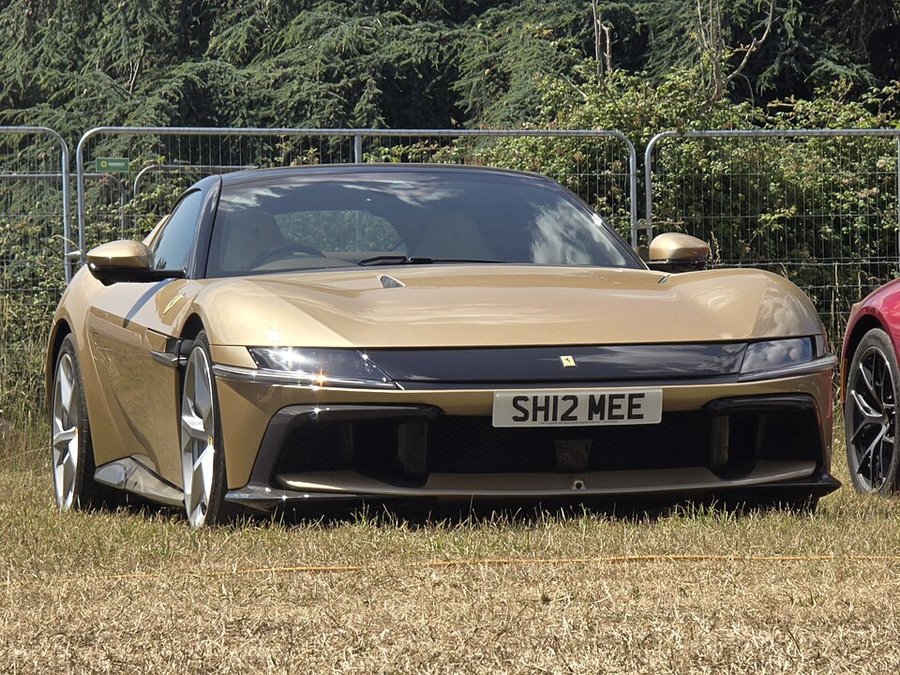
There is a moment, somewhere past seven thousand revolutions per minute, when a naturally aspirated V12 stops sounding like an engine and starts sounding like an argument being won. It is not noise in the way a turbocharged motor makes noise. It is structure — twelve pistons, six per bank, firing in an order that yields one of the most pleasing sounds engineering ever arrived at by accident. Ferrari has been making it since 1947.
This is the first car to appear in The Paddock, and it is no accident that it is this one. We have written here about saddles, about wax cotton, about boots designed for stirrups that ended up on catwalks — objects made properly once, then left alone. A Ferrari with twelve naturally aspirated cylinders belongs to that family: inherited engineering, refined rather than reinvented, kept by a company that could have abandoned it for something easier at any point in forty years.
The 12Cilindri does not have a poetic name. It has an inventory. Twelve cylinders — that is the whole of it, stated in Italian, without adjective or embellishment.
Why This Machine
A riding site writing about a motor car requires a small justification, and it is this: the pleasures are the same pleasures. Anyone who has ridden a good horse across open ground, or opened the throttle on a well-sorted motorcycle on an empty B-road, already understands what a V12 Ferrari is for. It is not transport. It is the deliberate seeking-out of a sensation with no practical purpose whatsoever, and worth arranging a life around for that reason.
The vocabulary carries over intact. Riders talk about balance, about weight transfer, about the moment a machine stops feeling like something you operate and starts feeling like something you are part of. Ferrari's engineers use the same words. The 12Cilindri is front-mid-engined — the V12 sits behind the front axle line rather than over it — for the reason a good saddle sits where it does: to put the mass where the machine can carry it.
Then there is temperament. A high-revving naturally aspirated engine is not obedient. It gives little at low revolutions and everything at the top, so it must be ridden rather than driven — read, anticipated, met halfway. A turbocharged car flatters the impatient. This one rewards whoever knows the good part lives at the top.
That is a very old-money proposition, and it is why this car belongs here. The 12Cilindri is not the fastest way between two points, nor the most sensible. It is the most beautiful way, and apologises for none of it.
The Beauty
Ferrari's Styling Centre, under Flavio Manzoni, did something genuinely unfashionable with this car: it took things away. Where the modern supercar has become a study in surface violence — vents that vent nothing, slashes and winglets piled on until the shape vanishes beneath its decoration — the 12Cilindri is long, uninterrupted volumes. The bonnet runs forward an unreasonable distance. The cabin sits far back. The tail is cut clean.
The defining gesture is at the front: a black band drawn across the nose, linking the headlights and reading as a single dark visor. It refers directly to the 365 GTB/4 — the car the world calls the Daytona — whose earliest examples wore a full-width transparent panel over fixed headlights, before American regulations forced pop-up units instead. It is a quotation, not a pastiche: the same idea in modern materials.
At the rear, active flaps are set into the tail. They lie flush when they are not needed and rise when they are, adding downforce under braking and at speed before disappearing again. This is the essential Ferrari trick — aerodynamic function living inside the bodywork rather than bolted onto it. There is no permanent wing, and nothing announcing itself while the car stands still.
The proportions are the oldest in the catalogue: engine forward, driver back, rear-wheel drive, two seats. The shape descends from the 1950s front-engined berlinetta and survives because it is correct. Beside almost any contemporary hypercar it looks understated to the point of severity. That restraint is not conservatism but confidence — the instinct that puts a Barbour owner in a jacket reproofed nine times rather than a new one.
The Power
The engine is a 6.5-litre naturally aspirated V12 producing approximately 819 horsepower — 830 in the Italian cavalli vapore Ferrari prefers — arriving at around 9,250 rpm, with a redline of 9,500. Those last two figures are the ones that matter. Almost nothing else road-legal with twelve cylinders spins that hard.
There are no turbochargers. No hybrid system, no electric motor filling in the low-rev torque, no battery added for a headline figure. Air arrives at atmospheric pressure and the engine makes what it can of it, which is a great deal, because Ferrari has spent seventy-nine years learning how. Drive goes rearward through an eight-speed dual-clutch transmission; the claimed sprint to 100 km/h is around 2.9 seconds, top speed above 340 km/h. Those figures are beside the point — cars with half the cylinders get close to the first.
What the numbers cannot express is the shape of the delivery. An engine of this kind builds. It does not arrive in a lump at 2,000 rpm and flatten out; it climbs, and keeps climbing, and the last two thousand revolutions are the ones you came for. The sound climbs with it, to a top note no forced-induction engine has quite reproduced.
"Every era believes its own machines are permanent. They never are. What survives is not the fastest thing built in a given decade but the most beautifully made — and the naturally aspirated V12 is the last of a line that will not be drawn again."
This matters now in a way it would not have twenty years ago. Emissions legislation, efficiency targets and the economics of engine development have removed the naturally aspirated V12 from almost every manufacturer that once built one. Ferrari has kept it, kept it unassisted, and said publicly that the V12 has a future at Maranello. Whatever the long run holds, cars like this are no longer being designed in numbers.
The History Behind It
In 1947, Enzo Ferrari put his own name on a car for the first time. The 125 S carried a 1.5-litre V12 designed by Gioachino Colombo — twelve cylinders in a capacity most manufacturers would have covered with four. It was an extravagant, borderline irrational decision, and it defined everything that followed. The Colombo V12 architecture, enlarged and developed over decades, powered Ferrari's road and racing cars through the marque's greatest years.
The front-engined V12 grand tourer became the house speciality: the 250 GT family, the 275 GTB, and in 1968 the 365 GTB/4 — the Daytona, so nicknamed after Ferrari's dominant finish at the 24 Hours of Daytona the previous year, a name the factory never officially adopted and the world used anyway. For many it remains the definitive shape of the type.
Ferrari then spent two decades elsewhere, its flagships mid-engined, before the 550 Maranello arrived in 1996 and put the V12 back where the company's own history said it belonged. The line has run unbroken since: 575M Maranello, 599 GTB Fiorano, F12berlinetta, and the 812 Superfast, which the 12Cilindri now replaces.
Which brings us back to the name. Ferrari has called this car neither after a place nor a race nor a horsepower figure, but after the layout itself — the one continuous thread running from 1947 to now. It is a statement of inheritance rather than novelty, and the most old-money thing the company has done in years.
What It Costs
Indicatively, as of early 2026, the coupe starts near €395,000 in Europe, around £336,500 in the United Kingdom and approximately $472,000 in the United States before options and taxes. The Spider — the retractable-hardtop convertible — sits roughly £30,000 to $43,000 above the coupe depending on market. Every one of these figures is a starting point, not a price.
That distinction is not pedantry. Ferrari's options list is one of the most consequential in the industry, and a specification of paint, calipers, carbon trim, wheels, seats and personalisation work can add a substantial proportion of the base figure. Local taxes, registration levies and import tariffs then move the landed number again — which is why the same car can differ by hundreds of thousands between two markets.
And there is the thing nobody advertises: for a flagship Ferrari, price is often the easier of the two obstacles. The harder one is allocation. Ferrari does not simply sell to whoever arrives with funds; the most desirable models are offered to established clients through their dealer, and a first-time buyer with the full amount in cash may well be told to wait. The money is necessary. It is rarely sufficient.
Where to Find One
New cars are ordered through Ferrari's official dealer network; there is no other legitimate route to a factory build slot. The table below orients rather than quotes. All figures are approximate as of early 2026, exclude options, and vary considerably with specification, local taxes and import duties.
| Market | Availability | Indicative Price |
|---|---|---|
| Italy & Europe | Built in Maranello; the deepest official dealer network and the shortest supply chain. Left-hand drive. | From approx. €395,000 before options and local taxes |
| United Kingdom | Full official network; right-hand drive built to order. Long-standing Ferrari client base. | From approx. £336,500 (coupe); Spider approx. £30,000 more |
| United States | Largest single market for Ferrari; broad dealer coverage. Federalised specification. | From approx. $472,000 (coupe); Spider from approx. $515,000 |
| United Arab Emirates | Official presence in Dubai and Abu Dhabi. Comparatively low import duty and VAT keep landed prices among the world's most competitive. | Broadly comparable to European pricing once converted; confirm locally |
| Japan | Official network; right-hand drive available. A mature market with a long V12 following. | Typically above European levels once taxes are applied |
| India | Officially represented, but volumes are small. Imported fully built, so customs duty, GST and cess apply on top of the landed cost. | Import duties and taxes can approach or exceed the value of the car itself; expect a total well above global levels |
The other route is the used market — Ferrari runs its own approved-used programme alongside the established specialists — where pricing is set by demand rather than the factory, and can sit either side of list.
A note on India, because it is routinely misreported: the country levies very high import duties on fully built cars in this class, and the combined effect of duty, tax and cess means the on-road figure bears little relation to European list price. Treat the factory price as a fraction of the true cost and take formal quotation from the official importer. Rates change; nothing here is current advice.
What Makes It Unlike Anything Else
Strip away the badge and a very small category remains: front-mid-engined, rear-wheel-drive, two-seat grand tourers with twelve naturally aspirated cylinders, sold new, today. Almost every competitor has turbocharged, electrified, downsized or withdrawn, and most twelve-cylinder cars still built are forced-induction or hybrid-assisted.
What separates it from the museum pieces it descends from is that it is genuinely modern underneath — four-wheel steering, brake-by-wire, active aerodynamics, a dual-clutch gearbox faster than the argument about whether it should be. The restraint is in the styling and the engine philosophy, not the engineering. This is no retro exercise, but a contemporary car that has declined one specific compromise.
And that is what places it in the same company as everything else we write about here. The Barbour reproofed rather than replaced, the saddle that outlives its rider, the boot built on a last unchanged in a century — none are nostalgic objects. They were made correctly the first time. The 12Cilindri follows the same principle, at extraordinary expense, by the only people still willing to pay it.
It will not last forever. Nothing does. But there is a particular pleasure in owning something at the end of its line rather than the beginning — a thing whose value is not what it might become but what it already is. Twelve cylinders. No turbochargers. Nine thousand five hundred revolutions per minute. Whatever comes next, this is what the end of the road looked like, and it looked magnificent.