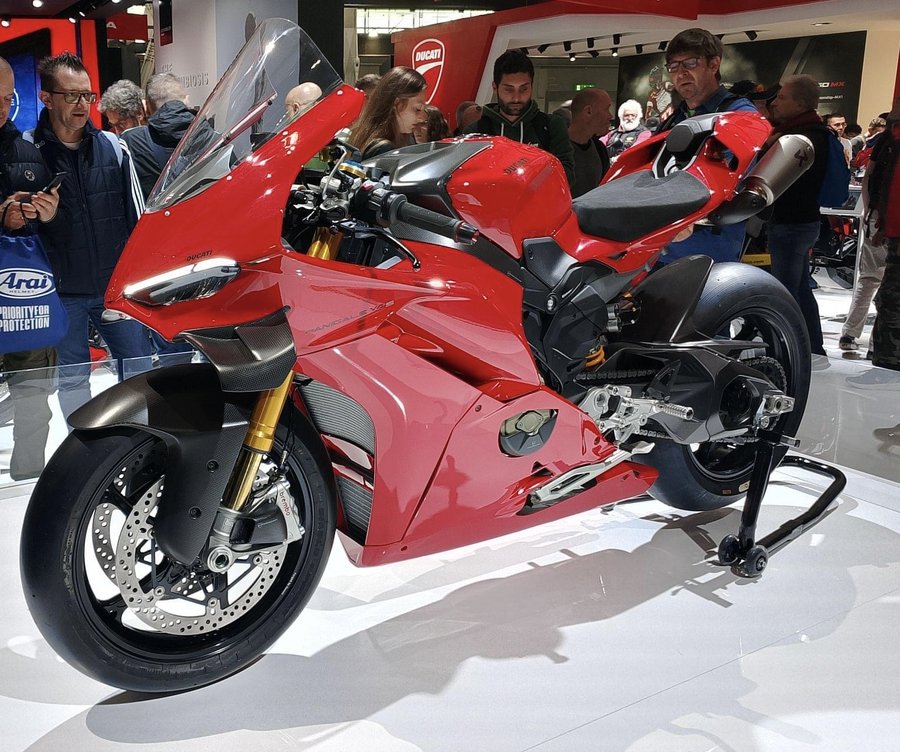
There is a moment, standing beside a Panigale V4 before the showroom opens, when the thing stops looking like a motorcycle. The red is too deep and too even; the panels meet with the tolerance of cabinetry. Its whole mass is gathered forward over the front wheel, the tail barely present. It is the newest object in the room, and yet it belongs here.
It belongs because the Panigale is the product of an unbroken argument — one house, in one district of one Italian city, insisting for seventy years that there is a right way to open and close a valve, and that the right way is worth the expense.
Why This Machine
The heritage collector distrusts the modern superbike, and usually with reason: fast in a way unrelated to skill, thick with electronics, superseded in three seasons. The Panigale escapes the charge because Ducati has never arrived at a design by consensus. It arrives by argument, and then declines to abandon it.
Consider what the company has refused to do. It has refused, for its entire motorcycling life, to close its valves with springs — an obstinacy that costs money in every engine it builds and buys nothing an accountant would approve of. It has refused easy engine layouts when difficult ones produced better machines, and refused comfort wherever comfort would have blunted the result.
That temperament is the one we recognise in a Purdey, a Patek, a properly made saddle: a maker holding to a fixed idea through decades in which the market would gladly have accepted less. The Panigale is not a heritage object because it is old, but because it is the current sentence in a paragraph begun in 1926, written in the same hand.
The Beauty
In profile, the first thing you notice is where the weight of the composition sits. Fairing, radiators, the forward-leaning bulk of the engine, the rider's own body — everything is pushed toward the front axle. The tail rises behind and simply stops: a thin blade of red carrying a numberplate. It is a prototype's silhouette, in which the tail is not a seat but whatever survives the removal of the unnecessary.
For most of the V4's life the signature at the rear was the single-sided swingarm, an inherited idea turned into an aesthetic principle: the rear wheel wholly exposed, the machine apparently standing on a spinning disc. The latest generation moved to a double-sided arm, chosen for chassis behaviour rather than beauty — a startling break with house style that tells you exactly where the loyalties lie. The winglets set into the fairing's flanks are the same instinct: MotoGP downforce, largely inert at legal speeds, worn like a tailor's working buttonhole.
And the red. Ducati Red is not a colour choice but an institution, part of an Italian tradition of racing red older than any marketing department. This is industrial design rather than styling — styling decorates a mechanism, industrial design lets it be seen. Nearly every line here is routing air, shielding heat or clearing a lean angle. That it is also beautiful is compound interest paid by good engineering.
The Power
The engine is called the Desmosedici Stradale, and the name is plain description: desmo for the valve system, sedici for sixteen valves, stradale for the road. A 1,103cc V4 with its cylinder banks set at ninety degrees, it makes comfortably more than 200 horsepower — figures around 210 to 215 hp are typical, depending on model year and market homologation.
Desmodromic actuation is the oldest idea in the machine and the least understood. Ordinarily a cam lobe pushes a valve open and a coil spring pulls it shut; at very high revs the spring cannot keep pace, and the valve floats away from the cam. Ducati removes the spring from the argument. A second lobe and a second rocker arm pull each valve positively closed, so it is under mechanical control in both directions — desmos and dromos, a bond and a course. More parts, more cost, and cam timing no sprung engine could tolerate.
The second idea is subtler and more immediately felt: the crankshaft turns backwards. Spinning against the wheels, its gyroscopic effect opposes theirs, so the machine resists changes of direction less and is markedly less inclined to lift its front wheel. It is a Grand Prix solution, adopted because this road engine descends directly from the racing Desmosedici that has carried Ducati through the premier class since the early 2000s.
"A superbike earns its place in a heritage collection at the moment it stops being merely fast and becomes inevitable — when no other house, in no other country, could plausibly have built it."
Around all of this sits an electronics suite that would have been science fiction to Taglioni. A six-axis inertial measurement unit reports the machine's attitude in space many times a second, and from that single stream come cornering ABS, traction and wheelie control, slide control, engine braking and the clutchless quickshifter. The effect is not to make the Panigale safe — it is emphatically not safe — but to make a brutal engine legible.
The History Behind It
Ducati was founded in Bologna in 1926, and it did not make motorcycles. The Società Scientifica Radio Brevetti Ducati made radio components for the new wireless age, well enough to build a proper factory at Borgo Panigale, on the western edge of the city, in the mid-1930s. That factory was heavily bombed during the war. What emerged from it found the Cucciolo — a clip-on engine, the "little puppy," that turned a bicycle into transport for a country with almost none.
The decisive appointment came in 1954, when Fabio Taglioni arrived as chief engineer. He brought desmodromic actuation to racing motorcycles in the 1950s and proved it in competition, and Ducati has never let it go — not a feature but a signature, carried across the range for seventy years. In the early 1970s he gave the company its second idea: a ninety-degree V-twin with the front cylinder near horizontal, which Ducati insists on calling an L-twin. In 1972 it won the Imola 200.
The L-twin era that followed was long and glorious. Liquid cooling and four-valve desmodromic heads arrived at the end of the 1980s, and through the 1990s Ducati's twins dominated World Superbike with an authority nobody has matched since. At the centre of that period stands the 916 of 1994 — Massimo Tamburini's design, with under-seat exhausts, trellis frame and single-sided swingarm — routinely named the most beautiful motorcycle ever made.
The Panigale name arrived in 2012, taken from the district itself, on a machine that made the engine a structural member of the chassis. Then, in 2018, came the break: the Panigale V4, the first Ducati superbike built in volume around four cylinders. It remains the closest thing the company has sold to its own Grand Prix machine.
What It Costs
Every figure below is indicative and approximate as of early 2026. Motorcycle pricing is never a single number but a local one, assembled from list price plus import duty, taxes, registration and dealer preparation. Two riders in two countries can pay sums differing by nearly half for the same machine. Treat these as bands, not quotations.
The range reads in three tiers. The base Panigale V4 carries the full 1,103cc engine and conventional — which is to say excellent — mechanically adjusted suspension. The V4 S, by some distance the most commonly seen specification, adds semi-active Öhlins suspension, forged aluminium wheels and a lithium-ion battery, and sits roughly a quarter to a third above the base machine.
Above both sits the V4 R, a different proposition entirely. It exists to homologate Ducati for World Superbike, where four-cylinder engines are capped at a litre, so it carries a smaller, shorter-stroke, higher-revving version of the engine with racing internals. Built in limited numbers at roughly double the price of a base Panigale, it is a racing motorcycle sold with lights on it.
Where to Find One
The Panigale is sold through Ducati's official network, and unlike most of what we cover in these pages, the answer to "where do I find one" is usually "the nearest city." The process is much the same everywhere: specification chosen, deposit taken, delivery in weeks. Limited editions and the R are the exception, often allocated before they are announced.
The used market deserves a caution. A Panigale V4 is a superb second-hand purchase or a catastrophic one, depending entirely on the previous owner. Desmodromic valve service is specialist work at specified intervals and is not cheap. A machine with complete official service history is worth a substantial premium over one without, and anything showing track use should be inspected by someone who knows these engines.
| Market | Availability | Indicative Price |
|---|---|---|
| Italy & Europe | Home market. Widest dealer network, shortest waits; special editions land here first. | From approx. €28,000 base; the S typically mid-€30,000s |
| United Kingdom | Strong dealer coverage and an active, well-documented used market | Roughly £23,000–£26,000 base; around £30,000 and above for the S |
| United States | Broad network; list prices quoted before freight, setup, tax and registration | Around $25,000 base; the S commonly in the low-to-mid $30,000s |
| India | Ducati India dealers in the major metros; import duty dominates the price | Approx. ₹30 lakh ex-showroom base; the S higher, on-road more again |
| Australia | Established network; prices normally quoted ride-away, including on-road costs | Broadly AU$40,000–AU$45,000 base; the S well above that |
| United Arab Emirates | Dubai and Abu Dhabi dealers; low duty makes the Gulf a favourable market | In the region of AED 110,000–130,000 base, subject to specification |
Currency and duty move faster than any published guide, so confirm figures with an authorised dealer before forming a view. And the standard machine is only the beginning: the accessory catalogues can add a substantial sum, and a fully specified S can approach R money without acquiring the R's engineering.
What Makes It Unlike Anything Else
Other superbikes make more than two hundred horsepower. Some are cheaper, some more forgiving, one or two quicker around a given circuit. None of them feel like this. The distinction is not a specification advantage but the accumulated eccentricity of a company solving the same problems, in the same building, its own way, since before most of its rivals existed.
You hear it first: nothing like an inline four, but a hard, uneven, cultured bark from a firing order deliberately arranged so that four cylinders behave, to the rider's right hand, rather like two large ones. You feel it in the way the machine changes direction, in a riding position that concedes nothing, and in a first mile that is genuinely intimidating and a tenth that is not.
And you see it in the fact that the Panigale is one of very few new motorcycles people photograph while it is standing still. That is the heritage test, and it is harder than it sounds; almost nothing built this decade passes. Parked outside a café, it draws the attention of a pre-war Bentley — not because it is expensive, but because it is unmistakably the work of somebody with a point of view.
In thirty years this machine will be spoken of here the way we now speak of the 916: as the moment a company with every commercial reason to compromise decided, once again, not to. Borgo Panigale has been making that decision since a radio-components firm rebuilt itself out of a bombed factory a century ago.