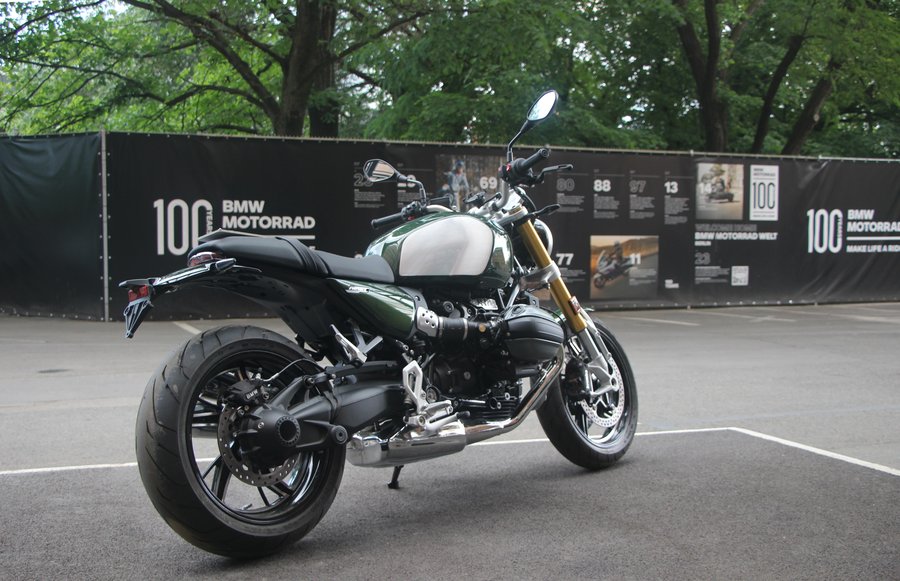
Stand beside a BMW R 12 nineT with the engine cold and your eye is drawn downward, past the tank and frame rails, to the two cylinders sitting in the open air where no sensible modern engineer would leave them. They stick out sideways into the weather, finned and black and slightly vulnerable, like the elbows of a man who has stopped caring what anyone thinks.
That posture is not a styling decision made in 2024. It was made in 1923 and never seriously revisited. What makes the R 12 nineT worth writing about is not speed — there are far faster motorcycles for the money. It is that it is legible. In an era when character is decided by software, here is a machine whose personality is dictated by physics you can see.
Why This Machine
There is a category of object that survives not by improving but by refusing. The Barbour jacket is one. The air-cooled BMW boxer belongs on the same list — a design that ought, by every measure of efficiency and packaging, to have been retired decades ago, and was instead carried forward on the strength of what it makes a rider feel.
It matters because it is among the last serious, factory-built expressions of that idea at scale. Air and oil cooling, a longitudinal crankshaft, shaft final drive, a round headlamp, a tubular steel frame you can follow with a finger from steering head to rear axle. Nothing about it is fashionable. All of it is coherent.
It also matters because BMW built it to be interfered with. The rear subframe unbolts. The seat unit comes away. The bodywork assumes a proportion of owners will remove it within the first year. Very few manufacturers of this size build a machine expecting the customer to know better. BMW did it twice.
The Beauty
The visual centrepiece is the engine, and BMW has done nothing to distract from it. The boxer's cylinder heads project outward at the widest, lowest point of the machine, and every other line leads the eye there. Where a sportsbike buries its engine, the R 12 nineT frames it.
Above sits the round headlamp — not a stylised interpretation of one, but an actual circle, mounted low enough that the rider looks slightly down onto it. It is the detail doing most of the heritage work. A round lamp reads as a face; it is why we describe old motorcycles as having character and new ones as having a design language.
The tank is where BMW allows itself some theatre. Beyond the painted finishes, the Option 719 treatments elevate the machine considerably — most notably the hand-finished brushed aluminium tank, left largely unpainted so the grain catches light differently from every angle. It cannot be photographed properly and must be seen in a showroom, which is either a marketing failure or the entire point. Option 719 also brings machined aluminium parts — covers, filler caps, levers, bar ends — closer to instrument-making than motorcycle production.
Then there is the customisation philosophy, the most genuinely unusual thing here. The bolt-on rear frame section exists precisely so owners and workshops can build café racers, scramblers and brat-style machines without cutting steel. BMW published an invitation. No two are quite alike after a few years, and the thoughtfully modified ones are frequently better looking than anything that left Berlin.
The Power
Roughly 109 horsepower, in 2026, is not a headline number, and nobody buys this motorcycle for peak output. What the 1170cc boxer delivers instead is torque available almost from idle, arriving without drama and departing without fuss. You do not hunt for a powerband. You open the throttle in whichever gear you are in and let the engine sort it out.
The first thing every new rider notices has nothing to do with going anywhere. Sit at a standstill, pull in the clutch and blip the throttle, and the whole motorcycle lurches sideways beneath you. This is torque reaction: because the crankshaft runs along the length of the machine rather than across it, spinning it up produces an equal and opposite roll through the chassis. The bike twists on its suspension and settles back, every time. Boxer owners do it in car parks for no reason at all.
"Every engine layout is a set of compromises made visible. The boxer simply refuses to hide which ones it chose."
The layout pays for that eccentricity with a real dynamic advantage. With both cylinders lying horizontally either side of the crank, the heaviest mass sits very low — lower than an inline or V-twin, where cylinders stack upward. The bike feels planted at walking pace, is easy to hold upright at a standstill, and changes direction with deliberate weight rather than a nervous flick. It is not light; it carries its weight in the right place. Add shaft final drive — no chain to adjust, no slack, no snatch on a closed throttle — and, with exposed cylinders warming your knees on a cold morning, you get what no water-cooled machine can imitate: the impression of sitting on top of a working engine rather than behind one.
The History Behind It
BMW Motorrad began in 1923 with the R 32, designed by Max Friz, which established the template still in use: a flat-twin mounted transversely with the cylinders in the airflow, and shaft drive to the rear wheel. It made around 8.5 horsepower from just under 500cc — a figure that means nothing now and meant a great deal then. What matters is the architecture. Friz did not merely design a motorcycle; he designed a company's grammar.
For a hundred years that grammar has been the constant. BMW has built singles, parallel twins, inline fours, sixes and one of the finest superbike engines in the world, and through all of it the boxer remained the thing the company is actually known for — through the Depression, the Dakar, decades of police fleets and continent-crossing tourers. The R 12 name itself reaches back to a BMW of the 1930s.
The modern chapter opens in 2014, when BMW launched the R nineT to mark ninety years of motorcycle production. It was a deliberate step backwards — no fairing, no touring intent, an air-cooled boxer in a stripped roadster with a modular frame — while the industry moved the other way. It sold far better than BMW appears to have expected and founded an entire Heritage line: the Scrambler, the Pure, the Racer, the Urban G/S.
In 2023 BMW Motorrad marked its centenary. The R 12 family arrived for 2024 as the answer to what comes next — a wholesale redesign rather than a facelift, with a new tubular steel frame, upside-down forks and a cleaner stance. The R 12 nineT took the roadster brief; the R 12 a lower, longer, cruiser-flavoured one. The engine, tellingly, stayed air and oil cooled. A century in, BMW is still building the motorcycle Friz drew.
What It Costs
All figures here are indicative and approximate as of early 2026. Pricing varies enormously with specification, taxes, import duties, registration and dealer terms, and the options list moves the number substantially. Treat them as orientation, not quotation.
Broadly, it sits around $16,000 in the United States, £12,500 in the United Kingdom and €16,000 in Germany for a base machine before extras and on-road costs. Those are entry points, not typical transaction prices; very few leave a showroom in base trim. Option 719 finishes and machined aluminium packages carry real premiums, and a well-specified example can sit several thousand above the headline figure in any currency. Markets with high import duties — India especially — land higher again.
On the used side, the R 12 nineT is young enough that supply is thin and depreciation modest. The wider R nineT family, in circulation since 2014, offers an appealing route in: the same 1170cc boxer and modular philosophy, at a fraction of the outlay.
Where to Find One
This is a current production model, so the primary route is the official BMW Motorrad dealer network — dense in Europe, well established in North America, Australia and Japan, growing in India. Approved used programmes are the sensible second option; independent specialists and custom workshops the third, and often the most interesting.
| Market | Availability | Indicative Price |
|---|---|---|
| Germany & Europe | Home market. Widest dealer network and deepest choice of Option 719 finishes; strongest used supply of earlier R nineT models. | From approx. €16,000, before options |
| United Kingdom | Broad dealer coverage and an active approved-used market; specced dealer stock commonly sits well above the entry figure. | From approx. £12,500 OTR; specced examples often £15,000–17,000 |
| United States | Sold nationally through BMW Motorrad dealers; a strong aftermarket and custom-build scene around the platform. | From approx. $16,000, before destination and options |
| India | Offered through BMW Motorrad India in major cities. Import duties and taxes push the figure far above European levels. | Roughly ₹20–24 lakh ex-showroom, by variant and year |
| Australia | Available through the national dealer network; ride-away pricing includes on-road costs and varies by state. | Approx. AU$26,000–28,000 ride away, by variant |
| Japan | Sold through BMW Motorrad Japan; the market also sees small limited-edition runs not offered elsewhere. | From roughly ¥2.5 million, including consumption tax |
Availability is broadly good across all six markets, but the mix differs. Europe and the UK see the widest spread of finishes and the deepest used supply. North America and Australia are well stocked but skew toward standard specification. India and Japan take smaller allocations, making waiting lists more of a factor than price alone.
One practical note: because the platform invites modification, condition assessment matters more than usual. Ask what has been changed, whether the subframe and wiring were altered, and whether the work was done by someone who understood the electronics. A well-built custom is a joy; a badly built one is a wiring loom with a headlamp attached.
What Makes It Unlike Anything Else
Plenty of manufacturers build retro roadsters. Almost all build a modern motorcycle and then dress it — a round lamp on a conventional chassis, heritage as a paint option. The R 12 nineT is not doing that. Its shape is determined by its engine, and that engine is genuinely the one the company has been refining since 1923. The look is a consequence, not a costume.
The second is the sensation nothing else offers. The sideways lurch on a blipped throttle, the low-slung mass, the shaft drive's honesty, the warmth of cylinder heads against your shins in November — these are not features. They are side effects of a decision made a century ago and never abandoned, and you cannot option them onto another motorcycle.
The third is the invitation. Very few machines at this price arrive from the factory implying the owner should make it theirs. The bolt-on subframe is a small piece of engineering with a large meaning: BMW built a motorcycle and handed over the pen.
Old money has always understood the difference between something expensive and something enduring — a Purdey, a Patek, a Barbour reproofed eleven times. The value lies in the object's refusal to be superseded. The R 12 nineT belongs in that quiet category. It is not the fastest thing you can buy, or the cleverest. It is the most continuous: a hundred years of one idea, carried forward without shouting. It does not ask to be admired for what it might become. It asks to be ridden for what it has always been.