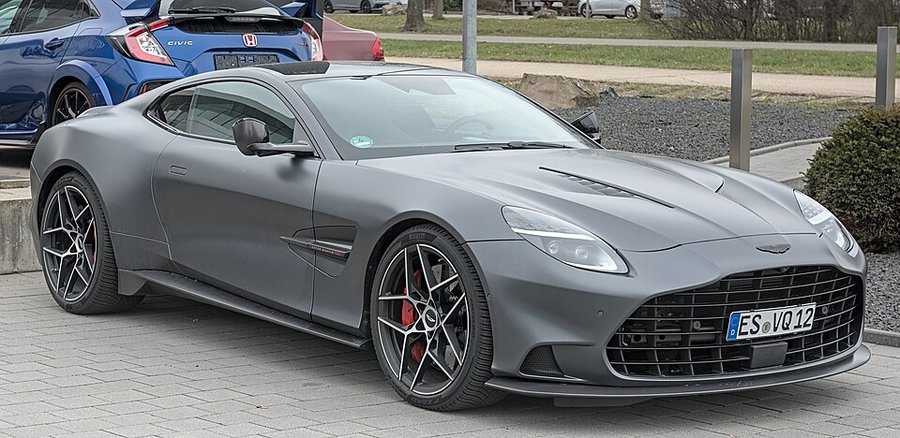
There is a moment, standing at the front three-quarter of an Aston Martin Vanquish, when the car stops being a product and becomes an argument. The bonnet runs away from you like a drive through parkland. The windscreen sits so far back it seems almost apologetic. Everything in the shape says the same thing: there is a very large engine under here, and the rest of the car has been arranged around the respect it is owed.
That arrangement — engine forward, cabin aft, two seats and a boot big enough for luggage that matters — is one of the oldest ideas in motoring and one of the least fashionable. The industry has spent two decades moving away from it. Aston Martin, in reviving the Vanquish name in 2024 and giving it twelve cylinders, has done the opposite.
Why This Machine
Old money is not about expense. Plenty of things are expensive and vulgar. Old money is about continuity — the sense that a thing exists because it has always existed, and that the people making it are custodians rather than inventors. By that standard the Vanquish is almost unfairly qualified. It is built in Warwickshire by a company founded in 1913, and its engine configuration was already old-fashioned when Aston Martin's founders were racing hillclimbs.
It also inherits a specifically British idea of how expensive things should be made. British coachbuilding was never about engineering supremacy; the Germans and Italians could always be argued to have had the better of that. What Britain did, from Mulliner and Park Ward through to the trim shops of Newport Pagnell, was treat a motor car as furniture that happened to move — upholstered, veneered and hand-stitched to fit its owner rather than assembled around them.
You can see that inheritance everywhere. The doors do not open upward. No wing rises theatrically out of the bodywork — the aerodynamic work is largely done underneath, where you cannot see it. It is fast in a way that only announces itself when asked: a car built to travel from a house in the country to a house in London at speeds that would horrify anyone told about them afterwards, without appearing to try.
The Beauty
The proportions come first, because with a front-engined grand tourer the proportions are almost the whole argument. The Vanquish has a very long bonnet, a cabin pushed decisively rearward, and a wheelbase noticeably longer than the DB12 with which it shares much of its structure. That extra length between the axles is not there for rear legroom — there is essentially none — but for stance. It is the difference between a car that is merely large and one that is properly imposing.
At the front sits the vaned grille, the largest Aston has fitted to a modern road car and the element that does most to establish the car's seniority. That flattened horseshoe has appeared on the company's cars, in one form or another, since before the Second World War, here scaled up to suit twelve cylinders. Behind it, the bonnet is a single enormous clamshell that opens forward.
Inside, the work becomes tactile. The cabin is hand-stitched, and the stitching is not decorative but the visible record of how the leather was attached. A horseshoe motif in the rear-quarter panelling quietly repeats the grille. The switchgear is physical — real buttons, a real rotary control in an anodised console — on the increasingly heretical view that a driver at speed should not have to look at a screen to change the temperature.
Then there is Q by Aston Martin, the factory's bespoke commissioning division, where the coachbuilding inheritance becomes literal. Q takes a customer's brief — a paint colour matched to something, a hide dyed to something else, a specific thread, veneer or inlaid crest — and executes it on the production line rather than as an aftermarket alteration. No two Vanquishes need leave Gaydon alike.
The Power
Under that clamshell sits a 5.2-litre twin-turbocharged V12 — Aston Martin's own engine, extensively re-engineered for this application, producing in the region of 823 horsepower and 1,000 Nm of torque. Drive goes to the rear wheels alone, through an eight-speed automatic and an electronically controlled limited-slip differential. Aston states a top speed of 214 mph, making it the fastest series-production car the company has built.
The interesting number, though, is twelve. Almost everyone else has left. Bentley ended production of its W12 in 2024 after more than two decades. BMW and Mercedes withdrew their V12s from general sale. Lamborghini's V12 survives only in hybrid form. Emissions, packaging and the sheer cost of an engine with that many of everything have driven the configuration towards extinction — and Aston Martin's decision to invest in one anyway is the clearest statement of what the company thinks it is for.
"A V12 has never been the efficient answer to any question. It is the answer to a different question entirely — what does power sound like when it is not straining?"
What twelve cylinders buy is not speed, which eight can supply, but character. Firing intervals that close together produce a smoothness and tonal complexity no smaller engine reproduces. Delivery is the other half: a large-capacity twelve does not lunge, it gathers, with torque available from almost anywhere. Production is deliberately limited — Aston Martin has indicated a ceiling of roughly a thousand cars a year, less a marketing device than an admission of what the car is.
The History Behind It
Lionel Martin and Robert Bamford founded their firm in London in 1913, initially selling and servicing other people's cars. Martin raced, with some success, at the Aston Clinton hillclimb in Buckinghamshire. When the two men built a car of their own, they named it for the hill and for Martin himself. The Aston Martin name is therefore not a founder's surname alone but the record of a place where a man went quickly uphill — a more romantic origin than most marques can claim.
The company spent its first three decades in near-permanent financial peril, a pattern that has recurred ever since. Rescue arrived in 1947 in the form of David Brown, the Yorkshire gear and tractor magnate, who bought Aston Martin and, shortly after, Lagonda. His initials gave the DB cars their name, and his money gave the marque its defining era: the DB2, the DB4, the DB5, and outright victory at the 1959 Le Mans 24 Hours with the DBR1 driven by Carroll Shelby and Roy Salvadori.
For most of the second half of the twentieth century, Aston Martins were built at Newport Pagnell in Buckinghamshire, a site the company occupied from the mid-1950s until car production there ended in 2007. It was a coachbuilder's factory in the truest sense — cars assembled slowly, panels worked by hand, output measured in the hundreds. The Gaydon plant in Warwickshire opened in 2003, though "higher volume" for Aston Martin has always been a relative term.
The Vanquish name itself arrived in 2001, on a flagship designed by Ian Callum and built at Newport Pagnell around a naturally aspirated 5.9-litre V12. It gained an outsized cultural presence as James Bond's car in Die Another Day in 2002, placing it in a lineage running back to the DB5 in Goldfinger. A second generation followed in 2012; then the name was retired, which in this industry is rarely permanent. Its return in 2024 revived not a model but a position — the twelve-cylinder car at the top of the range.
What It Costs
Indicative pricing sits from around £333,000 in the United Kingdom, approximately $430,000 in the United States, and roughly €390,000 across much of Europe. These are approximate figures as of early 2026 and should be treated as starting points only: actual transaction prices vary considerably by market, specification, options, local taxes, registration charges and import duties, and are subject to change.
The honest caveat is that almost nobody buys the car at that number. A flagship Aston Martin is sold through an options list, and once Q by Aston Martin is involved the figure moves substantially — bespoke paint, specially matched hides, carbon-fibre elements, wheel and brake choices and personalised detailing can add a sum that in many other segments would buy a complete car. A commissioned Vanquish arriving well beyond list price is the norm rather than the exception.
Limited annual production has historically tended to firm up residual values at the top of a range, particularly for the last generation of a disappearing engine configuration. That is an observation about how this market has behaved, not a prediction — nobody should buy a 5.2-litre V12 as an investment.
Where to Find One
The Vanquish is sold through Aston Martin's official dealer network, and allocation for a flagship of limited production typically goes to established customers first. The realistic route for a new buyer is to approach an official retailer, join an allocation list, and expect a wait. All prices below are indicative and approximate as of early 2026, and exclude the substantial cost of bespoke commissioning.
| Market | Availability | Indicative Price |
|---|---|---|
| United Kingdom | Home market. The densest official retailer network and the shortest route to a factory build slot. | From approx. £333,000 |
| Europe | Well-established retailer network across Germany, Italy, France, Switzerland and the Benelux. Registration taxes vary sharply by country. | From approx. €390,000 |
| United States | A core market for Aston Martin flagships, with dealers concentrated in California, Florida, Texas and the Northeast. State taxes additional. | From approx. $430,000 |
| UAE | Strong regional demand for V12 flagships, with official representation in Dubai and Abu Dhabi. Comparatively low import duty keeps landed costs favourable. | Broadly comparable to European levels before local charges |
| Japan | Official importer network and a long-standing enthusiast base for British GTs. Right-hand drive, which simplifies specification. | Broadly comparable to UK levels after local taxes |
| India | Availability is limited and official representation has been intermittent. Customs duty on fully built imported cars in this bracket is very high — well over 100 percent before GST, cess and registration — so the on-road figure can approach or exceed double the base price. | Substantially above UK list; confirm full landed cost first |
Anyone buying in a high-duty market should obtain a written, itemised landed-cost breakdown before signing. Duty structures change, and the gap between quoted price and on-road price can be larger than the price of an ordinary car.
What Makes It Unlike Anything Else
There is no shortage of cars that go faster, and none of cars that cost more. What there is a shortage of — an increasingly acute one — is the front-engined, rear-driven, twelve-cylinder grand tourer built by hand in modest numbers by a company that has been doing much the same thing for over a century. That category once had a dozen members. It now has perhaps two or three, and only one of them is British.
The Vanquish also resists the direction the rest of the segment has taken. It is not a technology demonstration: no hybrid system adding weight in the name of a headline figure, no all-wheel-drive safety net, no attempt to make the car feel smaller and sharper than it is. It commits fully to being a large, powerful, rear-driven two-seater — the format that produced the DB4, the DB5 and the original Vanquish — and asks the driver to meet it on those terms.
That is the old-money proposition: not novelty, but continuity executed to an extremely high standard. A shape that will read as correct in 2050. A cabin stitched by people. An engine chosen for how it feels rather than how it scores. Aston Martin has spent more than a century being nearly rescued, nearly ruined and nearly forgotten, and has emerged building beautiful, imperfect, deeply desirable cars that nobody needs. The Vanquish is the fullest expression of that stubbornness — the point at which a British company looked at the general retreat from twelve cylinders and decided, quietly and expensively, not to join it.